
How aMazing is Orion’s NebUla?
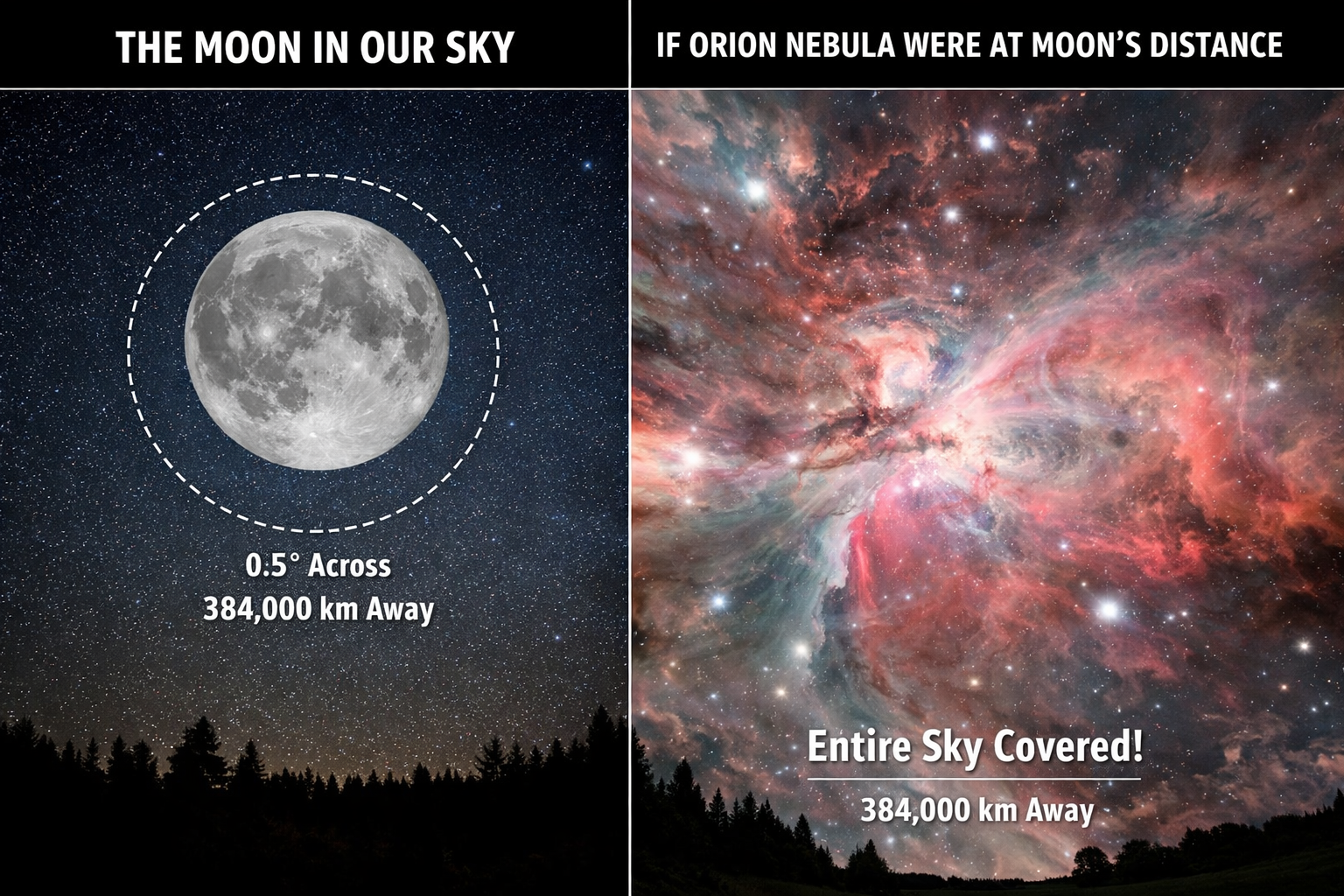
Imagine If Orion’s Nebula were located where our Moon is some 240,000 miles away. It would be the most dazzling sky and wrap around earth a few times.
Seeing Jupiter and Saturn at the Moon’s distance is impressive, but when you compare that to Orion’s Nebula, it really drives home the scale:
Orion isn’t just bigger than a planet — it’s tens of light-years across, containing hundreds of newborn stars. A single light year is 6 trillion miles. Our moon is only 2,160 miles across.
Your telescope only lets you see a tiny patch of this colossal stellar nursery, yet even that “tiny patch” is billions of times larger than the Moon in real space.
It’s one of those moments where astronomy really stretches your imagination — what your eye sees is just the tip of a cosmic iceberg.
Orion’s nebula can be found in Orion’s sword, hanging off the 3 star belt. A Massive Stellar Nursery!
Distance
The Orion Nebula (M42) is about 1,344 light-years away from Earth (modern measurements put it roughly 1,300–1,350 ly)
✅ It is the closest massive star-forming region to us
There are closer clouds of gas, but Orion is the nearest large, bright, active nebula where multiple stars are forming
Size / Width
The nebula is huge in real space:
≈24 light-years across for the brightest visible portion
If you include fainter outer extensions, it can be ≈33–40 light-years
Despite that, it appears only ~1° in the sky, roughly twice the width of the full Moon
Fun Fact
The Orion Nebula is part of the Orion Molecular Cloud Complex, which stretches over hundreds of light-years
It contains:
The Trapezium Cluster (young massive stars)
Protoplanetary disks (proplyds) — some of the first places we’ve seen baby solar systems forming
Quick Visual Scale
FeatureSize: Trapezium cluster~2 light-years
Bright nebula core~24 light-years
Fainter nebula wingsup to 40 light-years
Angular Size Comparison
Moon: ~0.5° across
Orion Nebula: ~1° across (bright part), up to 2° including faint wings)
If the Orion Nebula were at the Moon’s distance (~384,000 km):
Bright core: would cover the entire sky from horizon to horizon
Faint wings: would wrap around the Earth several times
Physical Scale
Actual Orion Nebula: ~24 light-years across
Moon distance: 240,000 miles
That means the nebula is billions of times larger than the Moon in reality
Tiny comparison:
Trapezium cluster stars: 1–2 light-years apart
If you shrank them to the Moon’s distance, each star would be hundreds of kilometers apart — still massive in your sky
Why This Feels Mind-Blowing
Your eye sees just a tiny “smoky patch”
But in reality, it’s a huge stellar nursery — hundreds of trillions of kilometers across
You’re literally looking at hundreds of newborn stars forming light-years away