
Venus, Mercury & Jupiter in Our June Sky
A short guide to the three‑planet lineup after sunset on Haleakalā
In the early evening at the Summit of Haleakalā, just after the sun slips below the horizon, a single brilliant “star” hangs low in the western sky. It’s not a star at all — it’s Venus, the brightest planet we can see from Earth.
Venus shines so intensely because, after our Moon, it’s the closest celestial body to Earth. Its thick clouds reflect sunlight like a mirror, making it appear almost diamond‑bright during the blue hour.
As twilight deepens and the sky turns from cobalt to black, another bright point appears nearby: Jupiter. Larger, farther, and colder than Venus, Jupiter is a massive gas giant — the heavyweight of our solar system — glowing steadily in the darkening sky.
Look a little lower, halfway toward the horizon, and you may catch a faint, quick‑moving spark of light: Mercury. It’s the closest planet to the Sun, which means it’s usually lost in the glare. But in June, from Haleakalā’s high, clear summit, Mercury peeks out just long enough to join the show.
Together, these three worlds — Mercury, Venus, and Jupiter — form a rare and beautiful alignment across the western sky. Two belong to the inner solar system, orbiting closer to the Sun than Earth. Jupiter lives far beyond them in the outer solar system, a swirling world of storms and moons.
Seeing all three at once is a quiet reminder of how dynamic our sky is. Every night on Haleakalā brings something new, but this June lineup is especially magical
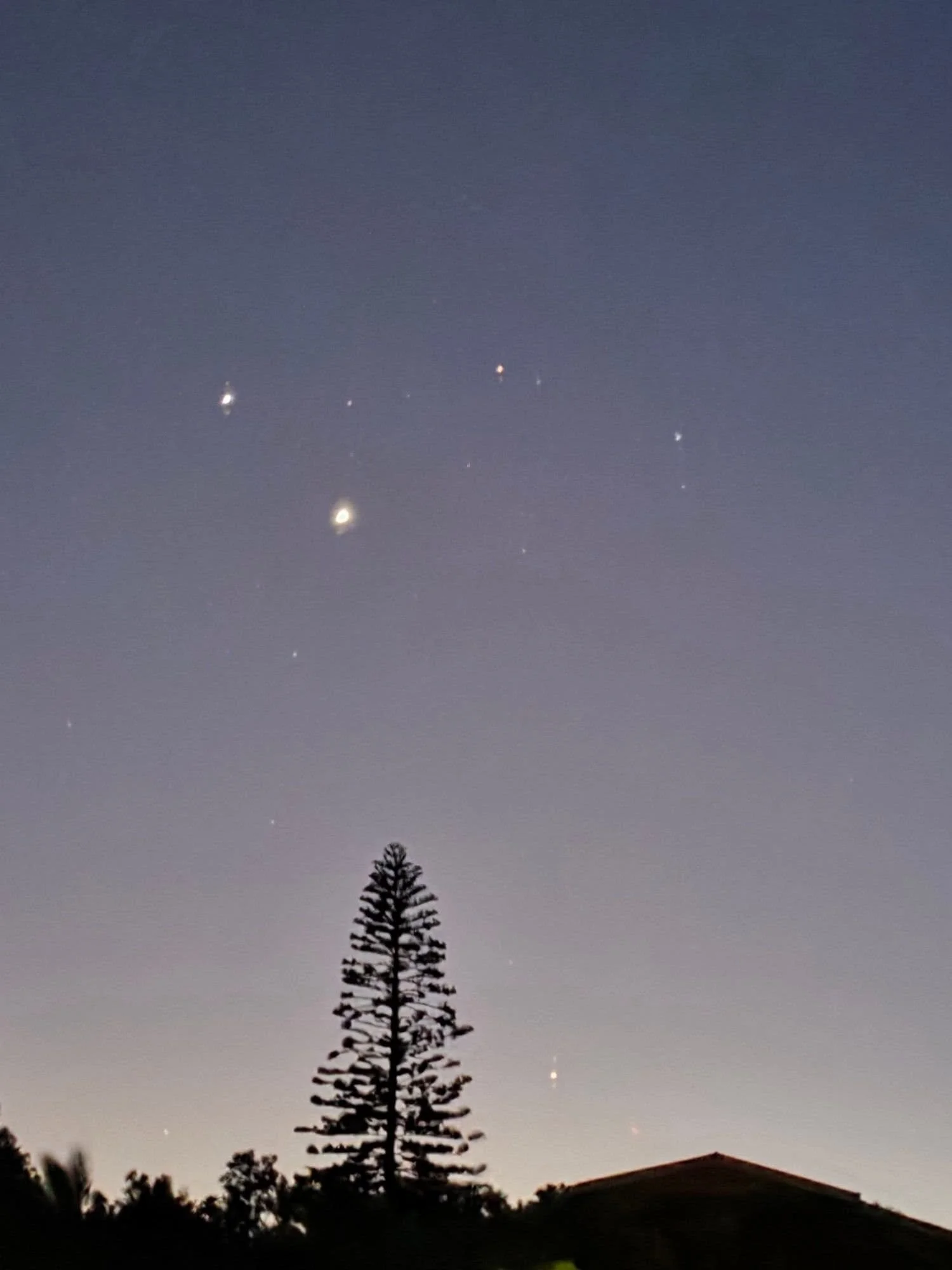
Jupiter, Venus and Mercury in the June Maui night sky